The Burned Hand: Violence Hidden in Plain Sight
The scene arrives without warning, embedded in the middle of a long complaint. Bedo is telling her friend Aishe about the day before yesterday. Her husband came home in a good mood. His sister Nebo slipped upstairs after him — fsht — and came back down claiming a headache. He paced and muttered through dinner.
AUTHOR & LITERARY HISTORYTRANSLATION
Albanika Press
6/23/20264 min read
The scene arrives without warning, embedded in the middle of a long complaint. Bedo is telling her friend Aishe about the day before yesterday. Her husband came home in a good mood. His sister Nebo slipped upstairs after him — fsht — and came back down claiming a headache. He paced and muttered through dinner. And then:
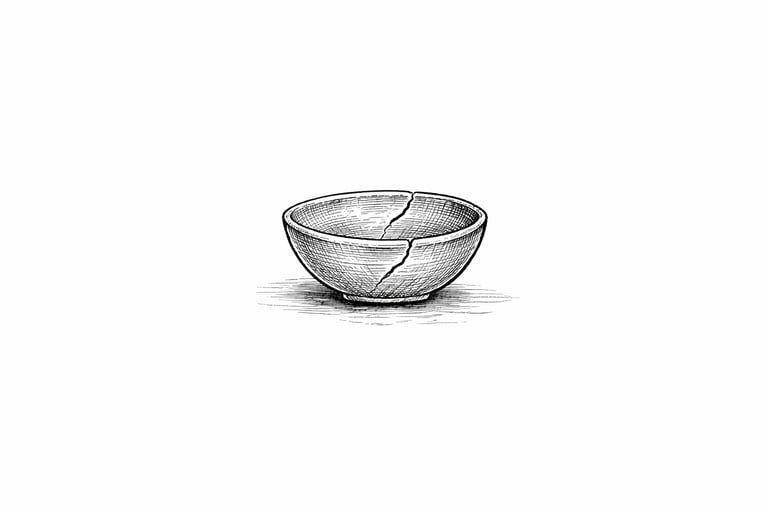
“As he is finishing, he shoots me a look, the way he always does when he’s in a rage… I didn’t open my mouth. I went and stood there, and as I lifted my eyes to him — fiu — he hurled the bowl he had in front of him. If I hadn’t ducked my head, it would have smashed my face to bits, but instead it caught my hand.”
Bedo’s response, in the moment, is silence. Not because she is unafraid, but because she is afraid the neighbors will hear. She pours lime water over the burn. It blisters through the night. By the time she is telling Aishe, her hand is swollen and open, far from healed.
Aishe’s response is practical: let me see it. Put linokoq balm on it. Don’t strain it, don’t put it in water. And — almost as an afterthought — take care of yourself, because if you fall sick, they will leave you in a corner without food or drink.
The story moves on. This is what makes the passage so striking.
Routine, Not Eruption
In She Is Deep, Musine Kokalari presents domestic violence not as a dramatic climax but as one episode in a longer pattern — a pattern so familiar to both women that it requires no special frame. It is not the worst thing Bedo has endured. It is not even, the story implies, the most recent. It is simply what happened the day before yesterday, and it is told in the same breath as the rummaged chest, the whispering on the staircase, and the refused marriage match.
This restraint is deliberate and precise. Kokalari does not editorialize. She does not slow the narrative to signal that something terrible has just been said. The scalding bowl, the blistered hand, the sleepless night — these arrive and are absorbed into the conversation the way Bedo herself has absorbed them: as part of the texture of daily life in this household.
What makes it visible — what keeps it from disappearing entirely into the background — is the physical detail. The sound of the bowl thrown: fiu. The hand catching it instead of the face. The heat of it, scalding. The lime water easing the burn only a little. The open wound Aishe examines the next day. Kokalari renders the body’s experience with precision, and that precision is where the moral weight of the scene lives.
The Architecture of the Story
The story is built as a confession — Bedo speaking to Aishe across the distance of their different domestic situations. The contrast is established from the first lines: Aishe lives alone with her husband, her house in order, her one sister-in-law rarely visiting. Bedo’s household is its opposite: crowded, hostile, ungovernable.
At the center of Bedo’s suffering stands Nebo, the eldest sister-in-law, who is described with a cascade of figurative images that accumulate into a portrait of concealed danger: she bites like a dog in the dark; she is a live ember under ash; a cloth worn on both sides; a dagger waiting to stab. These are Bedo’s words, and they are vivid precisely because they describe something that cannot be named directly — a form of harm that works through suggestion, whisper, and the strategically timed disappearance.
Nebo never speaks in the story. Like Mukades in the previous tale, she exists entirely through what others say about her. But where Mukades’s absence is shaped by grief, Nebo’s is shaped by design. She goes upstairs, says a word or two, and vanishes — psht — leaving behind consequences she will not witness.
The Moral Choice Bedo Makes
There is a moment in the story that could easily be passed over, but that Kokalari places with care. Bedo’s family has asked her to help arrange a marriage between Nebo and a relative — a match that would clear the thornbush from her doorway, as she puts it. She knows this. She refuses anyway.
“I could help with the match and clear the thornbush from my doorway, but why set another house on fire, knowing what kind of goods I have under my roof? That is not how things are done. I would rather die than arrange that match.”
This refusal costs her immediately. Nebo retaliates. The bowl follows. Bedo knows the connection and makes it plain in her account.
What Kokalari gives us here is not a victim defined entirely by what is done to her, but a woman capable of ethical reasoning under sustained pressure. Bedo chooses not to pass her suffering on to someone else, even when doing so would relieve her own situation. The choice is quiet, almost offhand in the telling — but it is the moral centre of the story.
By the time Bedo rises to leave — she has stayed too long, she says, and must not give Nebo cause to make her spit this visit through her nose — the title phrase finally arrives. She is deep, Bedo says of Nebo. Truly deep. She keeps everything hidden under her skin.
It is the last line of characterization, delivered as Bedo steps back into the household that will be waiting for her. The conversation ends. The door closes. And the story trusts the reader to hold what has been left in the room.
Old Neno’s Stories — the first English translation of Musine Kokalari’s work — is available now:
📖 Barnes & Noble: https://www.barnesandnoble.com/w/old-nenos-stories-musine-kokalari/1149899284
📖 Amazon: https://www.amazon.com/Old-Nenos-Stories-Selected-Literature/dp/B0GYGKL94G
Albanika Press
Independent publisher of thoughtful books.
Phone: +1-202-854-0140
Email: inquiries@albanika.com
© 2026 Albanika Press. All rights reserved.
Imprints:
Mesagjeritë Shqiptare — Translation & Cultural Preservation
Slim Shady — Illustrated Books & Series for Children