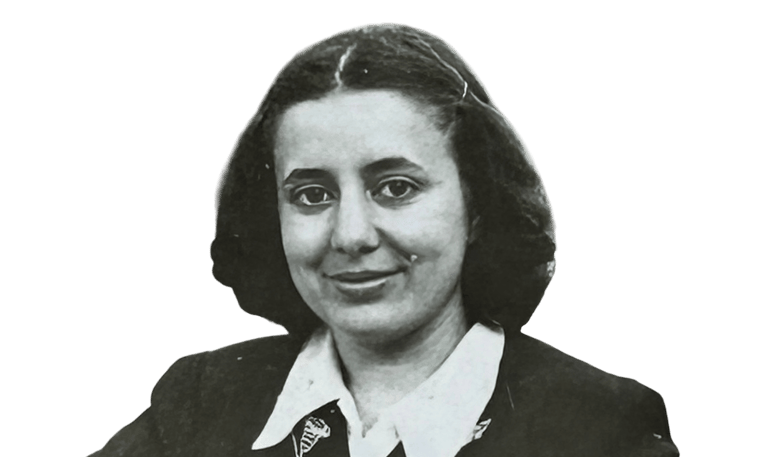
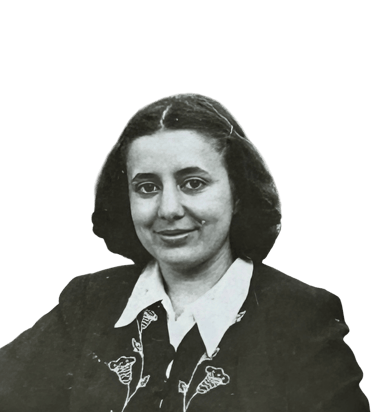
Musine Kokalari
1917-1983
Albania's first woman writer of literary prose
A Voice Before Its Time
Musine Kokalari was born on February 10, 1917, in Adana, Turkey, to an Albanian family originally from Gjirokastër. When she was three years old, her family returned to that city — the historic stone town in southern Albania that would become the setting, the heartbeat, and the moral landscape of everything she wrote.
She grew up the youngest of four children in an educated, politically engaged household. Her older brothers, Mumtaz and Vesim, guided her education and nurtured her early passion for literature and folklore. By the time she left for Rome in 1939 to study modern literature at La Sapienza University, she was already beginning to write.
The Stories
In 1939, while still a student, Kokalari wrote Siç më thotë nënua plakë — As Old Neno Tells Me — a collection of ten prose pieces rooted in the everyday life, speech, and customs of Gjirokastër. Published in Tirana in 1941, the book is recognized as the first work of literary prose published by a woman in Albanian literary history.
The stories unfold through conversation — through gossip, complaint, blessing, and memory. Their central figure is an elderly woman, sharp-tongued and tradition-bound, whose voice carries the accumulated experience of a community navigating the tension between old customs and new possibilities. The language is the spoken dialect of the south: vivid, idiomatic, rhythmically alive. The world it preserves is specific and irreplaceable.
A second cycle of stories, Nënua plakë në Romë (Old Neno in Rome, 1940), followed soon after, presenting humorous and observant reflections on the encounter between traditional Albanian sen- sibilities and modern European life. She published two further collections in 1944: Sa u tunt jeta (How Life Swayed), a substantial volume of 348 pages, and Rreth vatrës (Around the Hearth). Together, these books established her — briefly — as one of the most distinctive voices in Albanian prose.
She would never publish again.
Silenced
As World War II ended and communist forces consolidated power in Albania, Kokalari refused to align herself with the new regime. She had co-founded the Social Democratic Party in 1943, advocating for democratic pluralism and free elections. She launched the party's newspaper, Zëri i Lirisë (Voice of Freedom), in January 1944. She wrote openly, organized, and would not be silent.
The consequences were swift and devastating. In November 1944, her brothers Mumtaz and Vesim — co-founders with her of the publishing house Mesagjeritë Shqiptare — were executed by the communist authorities. Four days later, Kokalari herself was arrested for the first time.
On January 23, 1946, she was arrested again, tried before a military court as a "saboteur and enemy of the people," and sentenced to twenty years in prison. At her trial, she spoke words that have since become part of Albanian historical memory: "I don't need to be a communist to love my country. You are condemning me for my ideas. I do not ask for forgiveness because I have not done anything wrong."
She served eighteen years. Upon release in 1961, she was not freed — she was transferred to internal exile in Rrëshen, a remote northern town, where she lived and worked as a laborer on construction sites. Her books were banned and destroyed. She wrote extensively in her journals but she was forbidden to write for publication. She remained under continuous surveillance by Sigurimi — the Albanian secret police.
In 1980, she was diagnosed with breast cancer and struggled to find treatment at the state-run hospitals of the time. She died on August 13, 1983, in poverty and complete isolation — having spent nearly four decades silenced by a regime that feared what she had written and what she stood for.
Recognition
The communist regime fell in 1991. In 1993, Kokalari was posthumously declared a Martyr of Democracy by the President of Albania. A school in Tirana now bears her name. In 2017, the centenary of her birth, her image appeared on an Albanian postage stamp. She has been recognized by PEN International's Writers in Prison Committee, and she is the subject of scholarly attention in Albania, Kosovo, Italy, and beyond.
She was the first woman to receive the City's Honour of Gjirokastër — the city she never left in her imagination, even during the years when she could not return.
The Revival
In 1943 and 1944, Kokalari and her brothers published through a small press they called Mesagjeritë Shqiptare — Albanian Messenger. That press was silenced along with everything else.
Albanika Press has revived the name as an imprint dedicated to literary translation and cultural preservation — beginning with Old Neno's Stories, the first English-language translation of Kokalari's prose. To publish her work under the name of her own press is an act of remembrance as much as publishing.
"Here, where I was born and raised — in this mud I want to turn to dust."
Old Neno's Stories
Old Neno's Stories brings Kokalari's early prose to English-language readers for the first time. The illustrated edition presents selected stories from both As Old Neno Tells Me (1939) and Old Neno's Stories (1940), translated by Enit Lulushi, with an introduction and illustrations by Albert Lulushi.
Albanika Press
Independent publisher of thoughtful books.
Phone: +1-202-854-0140
Email: inquiries@albanika.com
© 2026 Albanika Press. All rights reserved.
Imprints:
Mesagjeritë Shqiptare — Translation & Cultural Preservation
Slim Shady — Illustrated Books & Series for Children